

Introduction
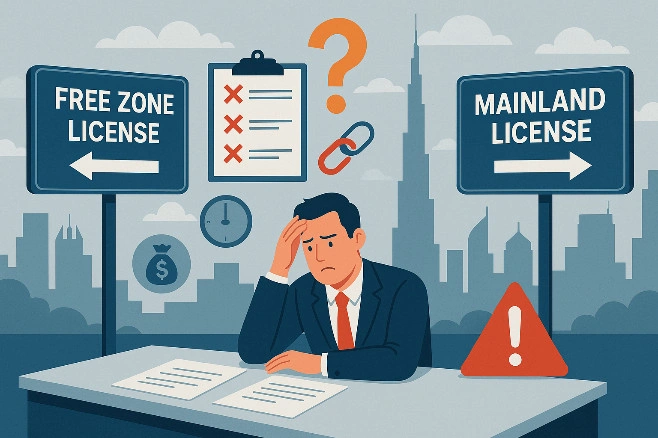
Changing from a Freezone license to a Mainland license enables wider market access, unrestricted onshore operations, and structural flexibility that directly supports business scale. Mainland licensing removes limitations related to client reach, contract eligibility, and geographic expansion, which commonly restrict growth once a business matures beyond its initial phase.
This content reflects direct operational exposure to licensing transitions within the UAE, regulatory coordination with authorities, and post-transition compliance outcomes. The objective is to explain how licensing structure affects scalability, control, and long-term operational resilience.
How License Structure Impacts Business Growth
Market Reach Constraints Under Freezone Models
Freezone licenses restrict business activity to designated jurisdictions or require intermediaries for onshore transactions. These constraints increase operational friction, slow deal execution, and reduce pricing control when scale depends on volume and geographic reach.
Bonus Insight: Businesses receiving consistent onshore inquiries often experience administrative delays under Freezone structures that compound as transaction volume increases.
Growth Enablement Through Mainland Licensing
Mainland licenses permit direct trade across all UAE emirates, including eligibility for government and semi-government contracts. This structure supports faster customer acquisition and diversified revenue channels.
According to UAE Ministry of Economy data, more than 70% of commercial growth since 2023 has originated from Mainland-licensed entities.
Source: UAE Ministry of Economy, 2024
Operational Control and Expansion Flexibility
Mainland entities operate without zone-imposed geographic limits. Office locations can be selected freely, activities expanded with fewer approvals, and workforce scale adjusted without predefined caps. These factors reduce expansion lead time and administrative overhead.
A 2024 World Bank review noted faster contract enforceability and higher counterparty confidence for Mainland entities operating in the UAE.
Source: World Bank Ease of Doing Business UAE Update, 2024
Structural Comparison Between Freezone and Mainland Licensing
| Operational Area | Freezone License | Mainland License |
| Client geography | Zone-limited or indirect | Nationwide UAE |
| Government contracts | Not permitted | Permitted |
| Office location | Restricted to Freezone | Anywhere in UAE |
| Activity expansion | Authority-dependent | Flexible under DED |
| Workforce scaling | Often capped | Unrestricted |
Regulatory and Compliance Considerations During Transition
Authority Oversight Shift
Transitioning from Freezone to Mainland licensing moves regulatory supervision to the Department of Economic Development. This affects reporting standards, inspection procedures, and activity classifications.
Tax and Record Alignment Requirements
Mainland operations involve broader VAT and Corporate Tax exposure due to onshore transaction volume. The Federal Tax Authority applies higher scrutiny to unreconciled or inconsistent filings for Mainland entities.
Source: UAE Federal Tax Authority Compliance Report, 2024
Bonus Insight: Align bookkeeping systems before initiating the transition to reduce post-license reconciliation delays.
Key Technical Definitions and Regulatory Scope
| Term | Practical Explanation |
| Freezone License | Authorization limited to a designated economic zone |
| Mainland License | Commercial authorization valid across the UAE |
| Onshore Activity | Direct transactions within UAE markets |
| DED Oversight | Regulatory supervision by emirate authorities |
Factors to Evaluate Before Making the Shift
Business Model Readiness
Assess whether future growth depends on direct onshore clients, government engagement, or multi-emirate operations. If so, Freezone limitations may outweigh structural convenience.
Compliance Capability
Mainland structures require disciplined bookkeeping, consistent VAT filings, and audit preparedness. Weak internal controls increase regulatory exposure post-transition.
Operational Continuity Planning
Bank accounts, visas, and contracts must be aligned to avoid disruption during the transition phase.
Strategic Questions After Transition
How long does stabilization take?
Most operations normalize within one reporting cycle once banking and compliance alignment is completed.
Does regulatory scrutiny increase?
Oversight increases, but clarity improves when records are maintained correctly.
Can activities be expanded later?
Mainland frameworks allow activity additions with fewer constraints.
Does ownership control change?
Most commercial activities allow full foreign ownership under current regulations.
Core Services Supporting Licensing Transitions
The Startup Zone provides focused support for operational continuity through the following services:
- Mainland License Processing
Regulatory coordination and activity alignment to ensure continuity. - Bank Account Opening
Structuring banking profiles aligned with Mainland compliance expectations. - Bookkeeping Services
Record management designed to withstand VAT and Corporate Tax scrutiny. - VAT Services
Compliance alignment for increased onshore transaction exposure.
Common Decision Questions Before Transition
Does scaling stall without Mainland access?
Yes. Dependence on intermediaries slows deal cycles and reduces margin control.
Is an office required immediately?
A registered address is mandatory, while physical expansion can remain phased.
Do existing contracts remain valid?
Contracts remain enforceable but may require legal alignment with the new entity.
Bonus Insight: Early contract novation planning minimizes renegotiation risk.
Summary and Direction
Licensing structure directly influences scalability, operational control, and compliance exposure. Freezone models support early efficiency, while Mainland licensing removes growth ceilings. Businesses should align the decision with market demand, internal controls, and long-term objectives.